
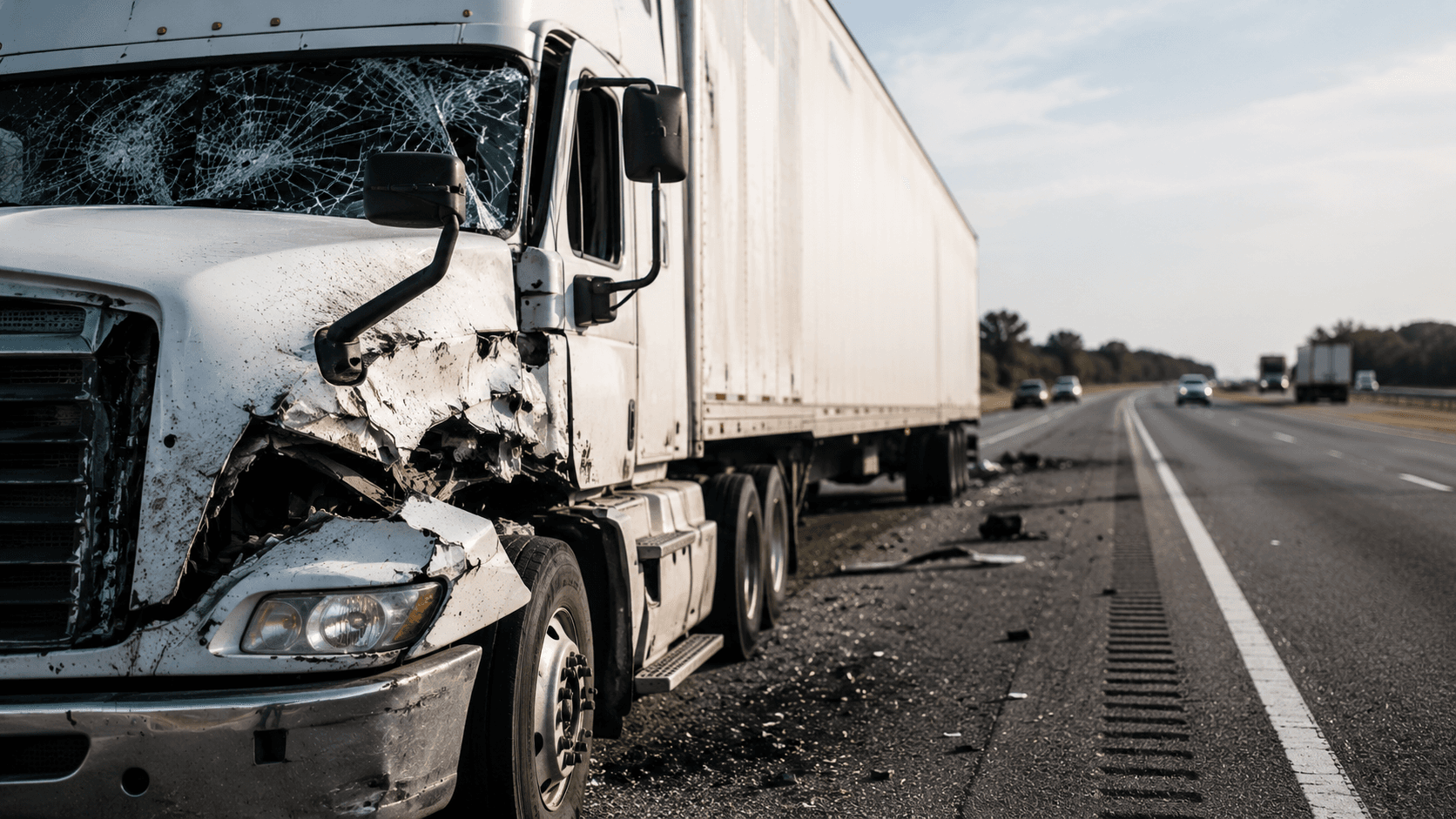
Short answer: A truck case is not a bigger car case. Federal law requires most interstate trucking companies to carry at least $750,000 in liability insurance (49 CFR 387.9), many times what a driver's personal policy carries. But the evidence that proves the case, the electronic logs and the driver's hours, sits with the trucking company and can be lawfully destroyed on a schedule measured in months. The two-year deadline to file (Va. Code § 8.01-243) is not the deadline that decides these cases.
A collision with an 80,000-pound commercial truck causes catastrophic injuries and a tangle of liable parties. I'm Scott Barney, and for over 20 years I've taken on trucking companies, their corporate insurers, and the federal rules that govern them, recovering full compensation for Hampton Roads victims on a no-win, no-fee basis.
The evidence is on a clock, and it is not two years
You have two years to file a lawsuit in Virginia. Almost nobody realizes the case itself can be decided long before that, because the proof does not live with you. It lives with the trucking company.
Modern trucks record a great deal: electronic logging device data showing hours behind the wheel, engine control module data showing speed and braking in the seconds before impact, dispatch records, maintenance history, the driver's qualification file, dashcam footage. Almost all of it is subject to retention schedules measured in months rather than years, and once it is gone lawfully there is no getting it back.
That is why the first real step in a truck case is a spoliation letter putting the carrier on formal notice to preserve everything. Sent in the first weeks it works. Sent at eighteen months it is a letter about documents that no longer exist. This is the single most avoidable way a serious truck case gets lost in Virginia.
Their investigator is already at the scene
This is the part that surprises people most. Major carriers and their insurers run rapid response teams. When a truck is in a serious wreck, the company can have an investigator, and sometimes an accident reconstructionist and a lawyer, at the scene within hours, while you are still in an emergency room.
They are not there to work out what happened. They are there to build the defense: measuring, photographing, interviewing witnesses before anyone else does, and getting the driver's account locked down early. None of that is improper. It is just a head start you never had.
So when the company's adjuster calls the next day sounding helpful and asks you to explain what happened, understand what that call is. It is evidence collection. You are not required to give a recorded statement, and in this state that decision matters more than almost anywhere.
The insurance is the reason these cases are worth fighting
Under 49 CFR 387.9, a for-hire carrier hauling ordinary freight across state lines in a vehicle over 10,001 pounds must carry at least $750,000 in public liability coverage. That figure has been in place since 1985. Carriers hauling hazardous materials must carry more, and many large carriers carry far above the minimum.
That is a different universe from an ordinary crash, where you may be arguing over a personal policy that runs out long before the medical bills do. In a catastrophic injury, whether there is enough insurance behind the claim often decides whether the case is worth bringing at all. In a truck case there usually is.
It also explains the resistance. Nobody defends a $750,000 exposure casually, which is why these cases attract serious lawyers on the other side from day one, and why they are not the sort of claim to try to settle over the phone yourself.
It is rarely just the driver you are claiming against
In a car crash there is usually one defendant. In a truck case there can be half a dozen, and finding them is a large part of the work. The driver. The motor carrier that employed them. The broker who arranged the load. The shipper. Whoever loaded the trailer, if the cargo shifted. The maintenance contractor, if a brake failed. The owner of the trailer, which is frequently not the owner of the tractor.
Each one may carry its own insurance, and each one may be pointing at another. A driver who was technically an owner-operator rather than an employee is the classic version of this, and the carrier will lean on that distinction hard.
Untangling it takes the paperwork, which takes us back to the first section. The documents that establish who actually controlled that truck are the same documents that disappear on a schedule.
One percent of fault still ends a truck case
Virginia's contributory negligence rule does not soften because the other vehicle weighed forty tons. If the carrier's insurer convinces a jury you were even slightly at fault, you recover nothing at all. Not a reduced share. Nothing.
They will look for it. Were you in his blind spot. Did you cut in too close before braking. Were you speeding a little. Should you have anticipated the turn. A professional driver making an unreasonable maneuver is still capable of persuading a jury that you contributed, and they have a reconstructionist who was at the scene while you were in surgery.
This is why how the rule works matters more here than in almost any other case type. The injuries are the worst, the insurance is the largest, and one percent still takes it all to zero.
What to do after a truck crash
Get the carrier's name and the USDOT number off the door or the trailer if anyone can. That number identifies the company behind the truck and it is the thread everything else pulls from. Photograph the trailer, the placards, and the cab, not just the damage.
Do not give the company's adjuster a recorded statement, however reasonable they sound. They already have their investigator's version. You are the only one who does not have a professional working on your account yet.
Then call me on 757-965-7200 the same week, not the same year. There is no charge for the conversation, and the reason for the urgency is not sales pressure, it is that a preservation letter sent early is worth more to your case than anything either of us does later. If you do not have a case, I will tell you.
Cases I Handle
Virginia Beach commercial truck crashes
How I Help
What I do for you
Move fast on evidence
I act quickly to preserve the truck's black-box data, driver logs, and maintenance records before they're lost.
Identify every defendant
Driver, carrier, broker, loader, manufacturer. I find each party that shares liability for your injuries.
Apply federal rules
I use FMCSA regulations on hours, inspection, and loading to prove negligence the insurer hoped you'd miss.
Negotiate or try it
I push for full value against the corporate defense and take it to a jury if they won't be reasonable.
What You May Recover
Compensation in a Virginia truck claim
- Emergency and long-term medical care
- Lost wages and lost earning capacity
- Vehicle replacement and property damage
- Pain, suffering, and permanent disability
- Future treatment and life-care costs for catastrophic injuries
Recent Results
Outcomes for clients
Case results depend upon a variety of factors unique to each case. Past results do not guarantee, warrant, or predict a similar outcome in any future case.
Truck Accidents FAQ
Questions I hear most
Related Practice Areas
Serving Hampton Roads
Hurt and not sure what to do? Let's talk today.
Free, confidential, and no obligation. You owe me nothing unless I win your case.